In line with its disaster response advocacy, BDO Foundation found ways to extend assistance to thousands of underserved Filipinos affected by a 7.0-magnitude earthquake that devastated parts of Northern Luzon.
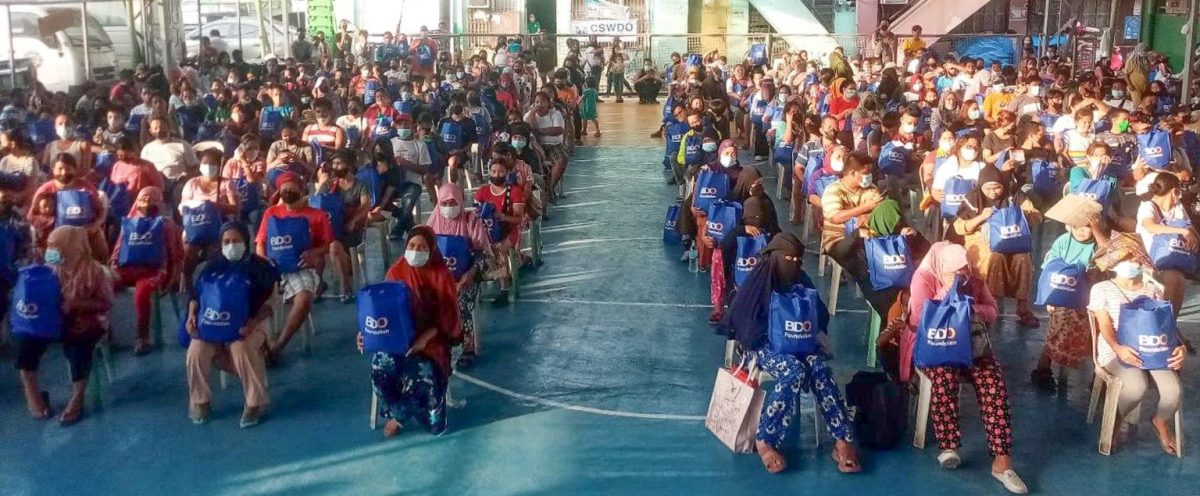
The foundation mounted relief operations in areas hit hardest by the tremors including the municipalities of Bangued, Dolores and Tayum in the province of Abra as well as Candon City and the towns of Caoayan and Santa in Ilocos Sur. It mobilized volunteers to visit evacuation sites and distribute relief packs containing food, rice and drinking water to 7,600 affected families in 26 barangays.
The initiative was made possible by volunteers from partner parishes, barangay officials and representatives of local disaster risk reduction and social welfare agencies. Philippine Army, Philippine National Police and Bureau of Fire Protection personnel provided security and logistical support. Officers of BDO and BDO Network Bank branches helped identify communities in need.
The relief efforts in Abra and Ilocos Sur were the latest conducted by BDO Foundation, the corporate social responsibility arm of BDO Unibank. The foundation also provided cleaning kits for 1,100 families in Banaue, Ifugao to help the community clean up dirt and debris scattered by the southwest monsoon. In Davao City, it distributed food packs to 300 families displaced by a fire incident.
As a follow through to its relief operations, BDO Foundation implements long-term rehabilitation and rebuilding programs in disaster-affected provinces.
Public school students and teachers in Benguet, Lanao del Sur, Negros Oriental, Palawan and Quezon stand to benefit from the donation of laptops.
In support of the Department of Education’s (DepEd) efforts to give more learners and educators access to computers, BDO Foundation and Huawei Philippines have partnered to provide laptops donated by Huawei to five DepEd schools divisions all over the country.
The partners recently turned over laptops to schools in Marawi City, Lanao del Sur in a ceremony led by Huawei Philippines and BDO Foundation officers.
Accepted by DepEd Marawi City schools division superintendent Anna Zenaida Unte-Alonto, the computers were distributed to Banggolo Elementary School, Madaya Lilod Elementary School, Mambuay Elementary School, Mamintal Disomangcop Central Elementary School, Marawi City Elementary School, Marinaut I Elementary School and Marinaut II Elementary School.
A few weeks earlier, Huawei and BDO Foundation also turned over laptops to schools in Dumaguete City, Negros Oriental. The event was witnessed by DepEd Dumaguete City schools division superintendent Dr. Gregorio Cyrus Elejorde, Huawei Philippines public affairs manager Chahol Liang, BDO Foundation president Mario Deriquito and the heads of BDO branches in the city.
The brand-new computers were distributed to Amador Dagudag Memorial Elementary School, Calindagan Elementary School, Cantil-e Elementary School, Hermenegilda F. Gloria Memorial High School, Junob National High School and West City Science Elementary School.
Aside from Dumaguete and Marawi, the corporate citizenship initiative also includes Benguet, Puerto Princesa City in Palawan and Tayabas City in Quezon. The donation forms part of an agreement DepEd and BDO Foundation signed with Huawei, the global leader in information and communications technology infrastructure and smart devices.
Jollibee Group Foundation (JGF) continues to support smallholder farmers by providing them access to technologically advanced farming techniques for more sustainable agriculture.
“Improving smallholder farmers’ knowledge and capacity for greater productivity and profit will redound to the continued growth of our agricultural sector,” said Gisela Tiongson, JGF Executive Director.
Launched in 2008, JGF’s Farmers Entrepreneurship Program (FEP) empowers and helps smallholder farmers sharpen their technical and business acumen, as well as partnership-building skills. Today, these farmers supply the vegetable requirements used in some Jollibee, Chowking, Greenwich, and Mang Inasal favorites.
“By becoming more adept and qualified to participate directly in the value chains of food companies, small producers get assured of a regular market, resulting in their increased and steady income,” Tiongson added. To reinforce support to smallholder farmers, JGF has adopted public-private partnerships to help farmers gain access to agricultural technologies that increase their yield, reduce farming costs, and make them more competitive in the market.
Weather data, farmer efficiency Since 2020, the Foundation has partnered with IBM’s The Weather Company for a more accurate community-level, 7-day weather forecast. JGF also worked with the Central Luzon State University to interpret the weather data and translate it into the prescribed farm practice for the day. The information is then shared in a private messaging group for faster dissemination among the farmers. The SMS feature of this system is now being developed for easier access.
The Onion and Vegetable Producers Cooperative (OVEPCO) farmers from Barangay Tabulac in San Jose City, Nueva Ecija were among the first to benefit from this system. Through the barangay-level forecasts provided, the farmers can adapt and better decide when to plant, fertilize, and harvest their crops.
“It has been helpful. Now we can prepare for what will happen tomorrow. It has become a guide for our daily farming,” shared Eddie Soriano, OVEPCO Chairman.
This project currently supports 116 farmers in 12 barangays in San Jose City, Nueva Ecija and Alcala, Pangasinan.
Healthy soil, healthy production In partnership with the Department of Agriculture’s Bureau of Soils and Water Management, JGF ventured into studying soil samples and providing practical recommendations to make the soil healthier and more viable for greater yield.
To help farmers improve their crops, JGF worked with the PUM Netherlands Senior Experts, various seed companies, and Jollibee Group’s own Research and Development team to find appropriate onion and bell pepper varieties that will meet the company’s requirement, and which can be more easily produced by the farmers.
Together with the Southeast Asian Regional Center for Graduate Study and Research in Agriculture, JGF is also looking into further increasing the productivity of onion farms. Called “Project SAYA” or Strengthening Agricultural Yield of Allium Cepa L. (Onion) in the Philippines, the project aims to help increase onion production by addressing inefficiencies, gaps, and factors affecting the level of production; as well as to identify potential and suitable areas for expansion.
“These agri-technology efforts are creating a ripple effect of empowerment and opportunities among our partner farming communities and institutions. They have reported greater knowledge on farming techniques, increased yield and income, and the confidence to transact with market players,” said Tiongson. “JGF will sustain these efforts so that farmer entrepreneurs can continue to gain greater pride in their profession and to reap the benefits of sustainable agriculture.”
Since 2019, the PUM Netherlands Senior Experts have guided farmers in soil testing and given them advice on soil health. They have also been assisting in varietal trials to test for better crop varieties, and introduce mechanization to improve productivity.
Security Bank Foundation, Inc. (SBFI), Security Bank’s Corporate Social Responsibility (CSR) arm, equipped 17 public schools in Central Luzon with portable media libraries and keychain microscopes to expand learning opportunities of students in the area.
SBFI turned over the educational resources on July 12 during a ceremony at Angeles City National High School in Pampanga. The 17 public schools received one portable media library which is an external hard drive containing over 1,500 Knowledge Channel developed video lessons, e-games, and e-session guides aligned with the Department of Education K-12 curriculum.
Three of the 17 public schools, which are national high schools, received an additional 244 keychain microscope sets called Makeroscopes, invented by Filipino engineer Jeremy De Leon. The tool is attached to a mobile device front camera to enable the viewing of microscopic samples up to x265 zoom. Each set also comes with sample slides of animal and plant cells.
“Learning resources play a vital role in the improvement of the quality of education in the region. Many studies show that those who have better resources often perform better. We thank Security Bank Foundation for recognizing this need and helping Region III address these gaps through their generous donation,’ says Dr. May Eclar, Department of Education Region III Director who led the acceptance of the donated educational resources by SBFI.
The recipient schools were beneficiary schools of SBFI’s Build a School, Build a Nation Program, the foundation’s flagship program which aims to improve the quality of basic education in the Philippines through building of classrooms in communities where Security Bank has presence while supplementing the infrastructure donation with major repair support, training for teachers and principals, and other learner support interventions.
The schools that received portable media libraries were; Angeles City National High School (Angeles, Pampanga), Banga High School (Plaridel, Bulacan), Bataan National High School (Balanga, Bataan), Calulut Integrated School (San Fernando, Pampanga), Calvario Elementary School (Meycauayan, Bulacan), Cong. Erasmo R. Cruz Memorial Central School (Bocaue, Bulacan), Gordon Heights I Elementary School (Olongapo, Zambales), Guyong Elementary School (Sta. Maria, Bulacan), Josefa V. Ycasiano Memorial School (Baliuag, Bulacan), Malhacan Integrated School (Meycauayan, Bulacan), Olongapo City National High School (Olongapo, Zambales), Sabang Elementary School (Baliuag, Bulacan), San Jose Elementary School (Tarlac City), San Juan Bautista Elementary School (Tarlac City), San Vicente Elementary School (Cabiao, Nueva Ecija), Sta. Rita Elementary School (Cabiao, Nueva Ecija), and Tikay Elementary School (Malolos, Bulacan). The schools that received the keychain microscopes were Angeles City National High School, Bataan National High School, and Olongapo City National High School.



 League of Corporate Foundations